Győr needs a new monster?
 Articles about incineration from the former Hungarian versions of Waste Diver (Kukabúvár)
Summer 2003 – Autumn 2004

Articles about incineration from the former Hungarian versions of Waste Diver (Kukabúvár)
Summer 2003 – Autumn 2004
 The incinerator between Dorog and
Esztergom was built at the end of the 80s for incinerating the
hazardous waste from three pharmaceutical companies. The trial run
was organized in December 1989, the hazardous waste incinerator today
works by 25 000 tons yearly capacity. Primarily it incinerates
solvents, distillation residues, sewage sludge, pesticides, medicines
and polluted working tools.
The incinerator between Dorog and
Esztergom was built at the end of the 80s for incinerating the
hazardous waste from three pharmaceutical companies. The trial run
was organized in December 1989, the hazardous waste incinerator today
works by 25 000 tons yearly capacity. Primarily it incinerates
solvents, distillation residues, sewage sludge, pesticides, medicines
and polluted working tools. "The only municipal waste incinerator in
Hungary operates in Budapest..."
"The only municipal waste incinerator in
Hungary operates in Budapest..."
 "The waste incineration justifies the
“throw away” think of way. It can make one believe that the waste
can be removed or disposed economically so no need to stop the waste
generation and consumption."
"The waste incineration justifies the
“throw away” think of way. It can make one believe that the waste
can be removed or disposed economically so no need to stop the waste
generation and consumption."
 The story of a Regional Landfill...
 In July 2003 EMLA (Environmental
Management and Law Association) and HuMuSz started a “watchdog”
project whose aim was to help people’s participation in making
decisions regarding waste management.
In July 2003 EMLA (Environmental
Management and Law Association) and HuMuSz started a “watchdog”
project whose aim was to help people’s participation in making
decisions regarding waste management.
 "Summer was raving. At the beginning
of July the more well-to-do Hungarian civilians tried to survive the
heat on the Balear Islands, while the poorer ones chose Margaret
Island (Margitsziget, in Budapest) or one of the lidos. We, however,
organised a two-day trip to the Container Islands that is that in the
recently finished HuMuSz house we held a forum about the questions of
selective waste management and its recycling."
"Summer was raving. At the beginning
of July the more well-to-do Hungarian civilians tried to survive the
heat on the Balear Islands, while the poorer ones chose Margaret
Island (Margitsziget, in Budapest) or one of the lidos. We, however,
organised a two-day trip to the Container Islands that is that in the
recently finished HuMuSz house we held a forum about the questions of
selective waste management and its recycling."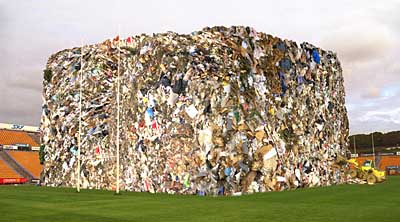 In the field of recycling Hungary is far from the international
standard. In 2000 30% of the non- hazardous waste and 20% of
hazardous waste were recycled in the industry. In spite of the
appearance of new technologies, only a small percentage of the
industrial waste, disposed earlier, becomes recycled. Yet, a
significant part of waste would be suitable for recycling. Owing to
the regulations and sources of the European Union in the past few
years more and more selective collection programs have set off. This
could give us joy, but we have some anxiety in this case (too).
In the field of recycling Hungary is far from the international
standard. In 2000 30% of the non- hazardous waste and 20% of
hazardous waste were recycled in the industry. In spite of the
appearance of new technologies, only a small percentage of the
industrial waste, disposed earlier, becomes recycled. Yet, a
significant part of waste would be suitable for recycling. Owing to
the regulations and sources of the European Union in the past few
years more and more selective collection programs have set off. This
could give us joy, but we have some anxiety in this case (too).
 Today it might sound
unbelievable that our grandparents didn’t use combined packaging to
store ultrapasteurized and „hiperhomogenized” milk in and they
survived somehow..."
Today it might sound
unbelievable that our grandparents didn’t use combined packaging to
store ultrapasteurized and „hiperhomogenized” milk in and they
survived somehow..."